Clear Memory Mac App
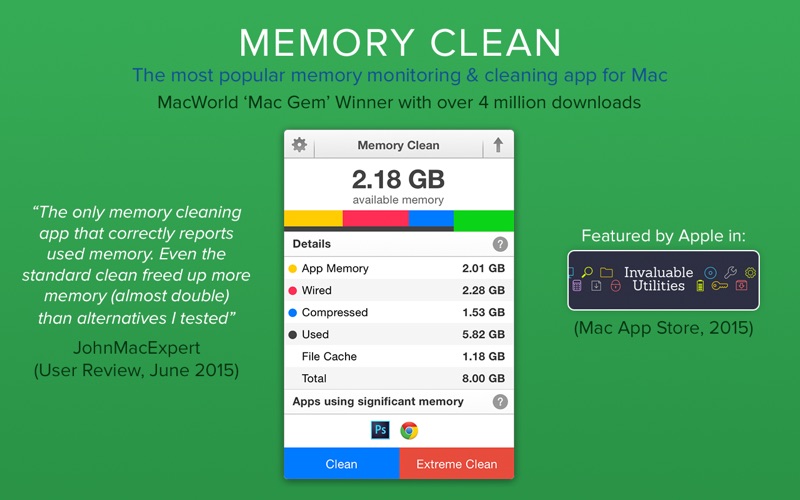
Memory Clean is an app for cleaning up your Mac OS X device memory at intervals. Memory Clean is available from the App Store or several download sites, and installs easily. Memory Clean is a free. The app will automatically clear RAM each time you quit large apps, your memory usage gets high volume or there is a low CPU usage on your Mac. Pros and Cons clearing RAM with Memory Cleaner Pros: Once you launch the app, you need to do nothing to free up RAM.
System cleanup in one click
Few things are more frustrating than your Mac telling you it has run out of memory when you're trying to be productive. It's more frustrating when you've ignored the problem for quite some time and your Mac's limitations simply won't let you put a solution on hold any longer.
- How to get rid of low memory notifications
Usually, a popup warning isn't the first sign that something is amiss. You may have noticed that your Mac isn't running as fast as it used to, with the fan louder than normal as if it's struggling to carry a heavy load up a hill.
Although Macs are wonderful computers, they have limitations. Thankfully, there is plenty you can do to resolve this problem and get your Mac operating smoothly again.
Reduce memory usage with Setapp
Instead of manually deleting files, get Setapp. It not only removes the clutter but also gives you full control over memory usage.
Your system has run out of application memory - Fix it
Mac memory usage is often occupied by apps, even browsers like Safari or Google Chrome. In the most dire circumstances, your Mac will toss a warning at you: 'your system has run out of application memory.'
Don't despair – it's solvable. The first thing to note is this is a natural issue; your Mac has a limited amount of RAM. Though more expensive Macs have more RAM, even they can butt against limitations when too many applications are running.
It may also be an app that is hogging all of your resources. This is especially true of older applications which haven't been optimized for modern computer architecture. Websites may also be a culprit.
Check RAM usage on Mac
To check your RAM use on any Mac, take the following steps:
- Open Activity Monitor from your list of applications
Note: You can do this is the Mac's control center, via the Finder in your Mac's dock, or by pressing command-space and typing 'Activity Monitor' in the Spotlight search field. - Toggle to the 'Memory' pane in the Activity Monitor window
As you see in the above screenshot, Activity Monitor shows you all of your processes, sub-processes, and how much memory each is taking up. The most pertinent portion of the window is the bottom, where it shows you the total memory usage, and how it's affecting your Mac.
A better way to monitor your Mac's memory use is with iStat Menus. After installing the app, it makes a home in your Mac's menu bar, and monitors just about everything, including memory, CPU, GPU, disks, and network usage.
You can choose which systems you'd like to monitor in the app itself. Only the items you're monitoring will have an icon in your menu bar. A simple click on the menu bar icon surfaces a drop-down menu of how your Mac is performing at the time, and hovering over each graphic brings up a larger menu, as you can see below.
How to check CPU usage on Mac
Checking CPU use on your Mac is similar to the steps above for checking memory use. For Activity Monitor, you'd make sure to highlight the 'CPU' section of the window. This will show you all the processes using your Mac's CPU at the time.
Similarly, iStat Menus has a 'CPU & GPU' toggle just above the memory section. Activating that will add a CPU and GPU monitor to your Mac menu bar, which has the same interactivity as the memory icon and menu shown above.
How to free up memory on Mac
Knowing how to clear memory on Mac is important, especially if you have a Mac with limited resources. One option is using Activity Monitor:
- Open Activity Monitor on your Mac
- Select an app using a lot of memory
- Click the 'x' icon on the top left of the screen
This is straightforward, but there's a better way. CleanMyMac X has an automated CPU and memory monitors built-in, which can give you a real-time view of memory usage in your Mac's menu bar. It also has a really quick and easy way to free up memory without digging through Activity Monitor and manually shutting down apps.
All you have to do is click the CleanMyMac X icon, select 'Free Up' in the memory pane, and the app takes care of the rest! Oftentimes, it doesn't even shut apps down.
This is a quick fix, but CleanMyMac X takes it a step further in the app itself. Under the app's 'Maintenance' section is an option to 'Free Up RAM,' which helps you clear RAM on Mac. Once you've got this option selected, simply select 'Run' at the bottom of the window, and CleanMyMac X will do a thorough scrubbing of your Mac's RAM, and clear unused files out of the way.
How to get rid of low memory notifications
Most apps are pretty good about how they use your Mac's resources. Having too many open or running in the background can severely limit what your Mac can handle, and is often why a Mac overheats or slows down.
Here are a few tips to reduce high memory usage manually if you're experiencing unique warnings or issues:
Fix 'kernel_task', a high CPU usage bug
You may have noticed through Activity Monitor something called kernel_task absorbing a large amount of processing power. One of the functions of kernel_task is to help manage CPU temperature; you may find that your Mac fan is loud and always on, even if the device isn't hot to the touch.
kernel_task usually performs this way when one or more applications are trying to use too much CPU. Unfortunately, one of the potential downsides is a Mac can overheat to such an extent that internal systems are damaged, sometimes irreparably.
Working through the following steps in this article is one way to avoid similar problems. If none of this work and kernel_task is still absorbing a high percentage of your CPU, then one or more of the following could be the cause:
- Cooling system inefficiency
- A failed or disconnected temperature sensor
- Another hardware issue, including a worn out batter
- Your System Management Controller needs a rest
If you're experiencing severe issues, Apple recommends a system management controller (SMC) reset. It's essentially a hard reset for your Mac, and should help your RAM and other hardware components start from scratch. Keep in mind you won't lose any data in this process.
Reduce memory usage in Finder
One common culprit for RAM issues is Finder, your Mac's file manager. If iStat Menus or Activity Monitor has highlighted Finder as using hundreds of MBs of RAM, there is an easy solution: change the default display for a new Finder window so it doesn't show All My Files.
- Click on the Finder icon in the Dock and click on the Finder menu, then select Preferences
- Click on General. Under 'New Finder windows show', click the dropdown menu and choose any option except All My Files
- Close Preferences, press Alt-Control, and click on the Finder icon in the Dock. Click Relaunch
Finder will now relaunch with new windows opening at the option you selected in step two.
Improve Chrome's Task Manager
Mac Clear Memory Cache
Chrome is a popular browser, but it's a resources hog! Chrome uses a GPU Process as standard, which means it speeds up the loading of web pages, which can be great except at times when your computer is struggling with insufficient RAM.
Here's how:
- Open Chrome on your Mac
- On the right side of the Chrome window, select the three-dot menu
- Select 'More tools'
- Select 'Task Manager'
- Select a Chrome process you'd like to kill
- Select 'End Process' at the bottom right of the window
Here's another way to reduce Chrome's use of your Mac's memory:
- Open Chrome on your Mac
- On the right side of the Chrome window, select the three-dot menu
- Select 'settings'
- Scroll to the bottom of the page and select 'advanced'
- Scroll down to 'System,' and toggle 'Use hardware acceleration when available' off
This will affect how Chrome runs on your Mac, and your experience won't be as smooth. You can also remove unused or unwanted Chrome extensions to help it use less resources on your Mac.
Get CMM X to free up space
Install CleanMyMac X and streamline the entire process of memory management on Mac. Clever memory usage control done for you.
Clean up browsers
In every browser you use regularly, there are always going to be extensions and popups that take up space and use RAM. You can manage each one manually, or use a tool such as CleanMyMac X to identify and delete them.
In the CleanMyMac X app is a section titled 'Extensions,' which lists each extension you have for your browser or browsers. All you have to do is view the list of extensions, select the ones you no longer want, and remove them. It's really that simple!
Disable login items
Login items, browser extensions, and preference panes, such as Flash, are another common source of memory usage. Most of us have several installed that we rarely use, but which hog memory and reduce performance.
One way to do this is through System Preferences:
- From your Mac menu bar, select 'System Preferences'
- Select 'Users & Groups'
- Select 'login items'
- Deselect items you no longer want active at login
Another way, one that is even quicker, is to employ CleanMyMac to identify and cleanup login items.
- Open CleanMyMac X
- Under 'Speed,' select 'Optimization'
- Select 'login items'
You can remove all login items, or select the ones you'd like to remove individually on the right side of the window.
Disable desktop widgets
Older Macs running a version of macOS older than Catalina can disable widgets. Desktop widgets can provide a useful shortcut to apps you need to access fairly often. But they can take up processing memory that is slowing your whole Mac down. One way to close them completely is in System Preferences.
Go to: Mission Control > switch off the Dashboard
Declutter your desktop
Apple's built in decluttering tool is handy for many. All you have to do on your cluttered desktop is right-click, then select 'Use Stacks.' This places all of your desktop files into folders unique to their filetype, like 'screenshots' and 'images.'
A better way is to use Spotless, an app that gives you far more control over how your Mac is organized. It has several triggers for automated cleanup of files on your desktop, placing them wherever you see fit. It's particularly useful for power users who produce several files daily, but don't want to take the time to place each in a respective folder.
You can also select many files on your Mac desktop, and tell Spotless to tidy them up. You always have full control!
Schedule regular cleanups
Constant use of your Mac, or leaving it on all the time, will slow it down over time. Shutting it down and restarting is a traditional way of 'cleaning up' a computer.
We also like CleanMyMac X's scheduled cleanup feature. Telling the app when you'd like to perform a thorough cleaning up of your Mac's system is a method many prefer to shutting down and restarting often. It has the upshot of removing files and folders you no longer use, and cleaning up tasks that are slowing your Mac down behind the scenes. A simple shutdown may not do this.
Keeping your Mac in tip-top shape is critical. While we'd all like to think computers are brilliant little devices that can handle anything, they need some care, too.
All of the apps mentioned in this article help with taking care of your Mac, and protecting your investment. Best of all they're each free as part of a seven day trial of Setapp. Give it a try today!

Meantime, prepare for all the awesome things you can do with Setapp. Best mac app to clean space on laptop.
Read onSign Up
Cache is basically a technical data that is stored when an app, browser or system performs a task. Cache files serve a vital function as they contain a “shortcut” to a task in order to perform it faster the next time.
Why should you clear cache on Mac?
Cache is meant to help your Mac load sites faster, but sometimes it brings more harm than good. For example, if the website you’re about to visit has been updated ever since your Mac cached its data, your browser will still load the outdated cached version of the site. The outdated cache may be the reason why some websites behave laggy.
Old cache files that remain latent in the system do nothing but piling up, cluttering your system folders. What was initially useful becomes a drag, slowing down your Mac through all the wasted space it is taking up. To make it even worse, undeleted cache data also leads to task conflicts and other system issues.
It’s staggering how much space can in fact be occupied by app/user cache on Mac. Wondering how much storage you’ve lost already? Well, it’s different for everyone, but it’s safe to assume several gigabytes at the very least.
Here are the three main categories of cache data:
- Browser cache
- System cache
- App (or User) cache
How to clear all types of cache on Mac step by step
Now, if you’re ready to finally get down to business, we’re going to walk you through both the manual and the automatic solutions to clear your cache.
To play it safe, back up the folders mentioned in the steps below. If everything works as it should, you can later delete these backups. Or you can skip the manual steps and go straight to Quick Tip (the safe and easy method).
1. Clean app cache on Mac manually
To delete app cache (which is also called user cache) manually, follow these steps:
Clear Ram Mac
- Open Finder and select Go > Go to Folder
- Type in ~/Library/Caches and hit Enter
- Backup the folders if you are worried about something going wrong
- Keep the folders, but go into each one and delete the files inside
2. Delete system cache
System cache doesn’t take much space, and it’s usually files generated by OS. You need to be particularly careful when clearing the system cache manually to avoid erasing vital system files.
To remove the system cache completely, follow the steps above, but this time go to /Library/Caches (without the ~). Don’t delete folders: you can only clear what’s inside of them. When you’re done, just empty the Trash to finish the job.
Quick Tip: get rid of system/app caches in one click
Clearing app caches manually is a tough nut to crack. To do the job in a fraction of the time (and without the risk of losing something important), you can fire up a dedicated cache cleaner app, CleanMyMac X. It will find and clear all your app caches blazing fast.
See how easy it is with these steps:
- Download CleanMyMac X (it’s free to download)
- Run the app and click on System Junk
- Click on the big Scan button
- When it’s done scanning, click Review Details to see what it has found
The User Cache Files contain app and browser cache. If you use lots of apps, cache can accumulate quickly and take up a lot of your disk space.
When the scan is complete, press the Run button to clear the cache and other junk.
3. Clear Internet cache on Mac
Clearing browser cache has two good things about it: it frees up space for your Mac to run faster and it removes your browsing history, making sure nobody ever finds your digital trail. Since each browser deals with caches differently, we’ve broken the cache-clearing solutions to three main browsers – Chrome, Safari, and Firefox.
If you’re uncomfortable deleting cache manually and prefer a less time-consuming approach, you can skip down to “How to clear all browser cache easily” to remove all your browser caches in one go.
How to empty cache in Safari
In Safari, clearing cache is as easy as it gets. Just go to History and click Clear History in the menu bar. Your cache and website history will be cleared immediately. If you prefer knowing exactly what you’re clearing, you can do that with a few more steps.
To empty cache on Safari with manual methods:
- Go to Safari > Preferences
- Select the Advanced tab
- Enable Show Develop menu
- Go to the Develop section in the menu bar
- Click on Empty Caches
How to clear browser cache in Chrome
When it comes to Chrome, clearing cache on Mac requires the following steps:
Mac Memory Store
- Click the Google Chrome settings icon in the top-right browser window
- Choose Settings
- Choose History and click Clear browsing data
- Make sure Cached images and files are checked
- Choose the Beginning of Time to clear all your cache
- Click the 'Clear browsing data' button to finish
How to delete cache in Firefox
And here’s for Firefox users (it’s even simpler than with the previous two). Just proceed with the following:
- Navigate to History > Clear Recent History
- Select Everything from the time range menu
- Click the arrow next to Details and make sure only Cache is checked
- Click Clear Now
How to clear all browser cache easily
So you decided to ditch the manual way and skipped to the automatic method. Congratulations! This is the quickest and safest way to remove browser cache. Instead of doing it manually through your browser settings, you can gain full control over all your cache and history data with CleanMyMac X. It’s an easy cache cleaner that will do the job like a charm. Follow these steps to clear all your browser caches:
- Run CleanMyMac and go to the Privacy module
- See all your browsers listed, select any of them
- Tick items you want to clean
- Finally, click Remove to clear your browser
A final reason to clear cache on Mac
Cache data works wonders for your Mac and system, but over time it can pile up and slow down your Mac’s performance, taking up the increasing amounts of space.
Hopefully, our guide will be everything you needed and more to free up gigabytes of valuable space and reclaim it by cleaning cache.
Best of all, we’ve also revealed how an automatic cache cleaner like CleanMyMac X makes removing cache as easy as a child’s play. Download the free version of the app here.
Let us know how it goes!